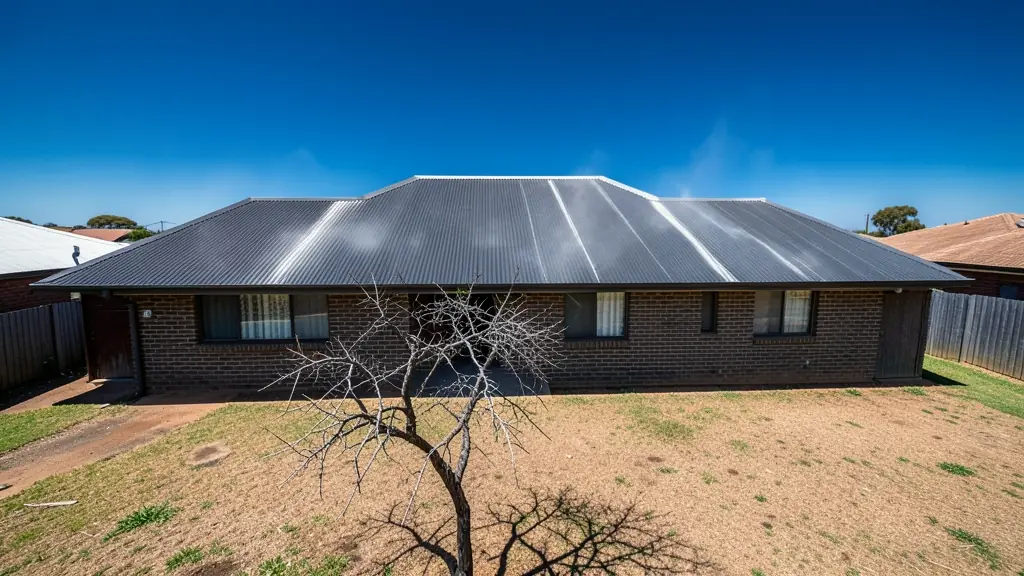
What is thermal insulation? It is any layer that slows the flow of heat from a warm place to a cooler one. It does not make heat or cold, it only buys time. In a South African house that matters most at the roof, where the summer sun lands hardest and winter warmth rises to escape. This page covers the plain physics: the three ways heat moves, what R-value and U-value mean, how brick and concrete behave, and where insulation pays back fastest.
Three ways heat gets through a roof
- Radiation. The sun heats the roof covering, which then glows heat downward across the roof space onto the ceiling. On dark tin this is the big one. Foil with an air gap reflects much of it.
- Conduction. Heat passing through solid stuff: tiles, timber, ceiling board. Wool, polyester and foam resist it because they are mostly still air or gas.
- Convection. Warm air rising and moving. Hot air builds up in the roof space; warm room air leaks out through gaps around hatches and downlights.
R-value and U-value in plain words
R-value measures resistance: thickness in metres divided by the conductivity (W/mK). Glass wool and polyester sit around 0.035 to 0.045 W/mK, XPS board about 0.030 to 0.035 and polyurethane foam about 0.022 to 0.028, lower being better. Add the R of every layer for the roof total. U-value is the flip side, one divided by that total: the heat that leaks per m² per degree. A low U is good. Try your own layers in the R-value calculator.
Thermal mass is not insulation
Thick brick and concrete soak up heat slowly and give it back hours later. That delay keeps a double brick house cool until late afternoon, then warm into the evening. Insulation does something else: it slows heat passing through. A tin roof house with a thin ceiling has neither, so it heats up within an hour of sunrise and cools fast after dark. The best houses use both: mass inside the rooms, insulation over the ceiling.
Where thermal insulation pays back
The roof first. In summer most heat enters through it, and an uninsulated ceiling is usually the biggest single gap in the house. After that come gaps and draughts, the geyser and its pipes (see pipe and geyser insulation), then walls and windows. Payback is quickest where you run aircon or heaters, as the insulation savings calculator shows for your area.
What to put in your request
- Say whether summer heat or winter cold bothers you more
- Describe the roof covering and the ceiling
- Mention if you run aircon or heaters
- Give the ceiling or roof area in m²
- Ask for R-values in writing for each layer
Thermal Insulation: who asks for them and why
- Homeowners and tenants: understanding why the house overheats in summer before choosing what to put in the roof
- Landlords, complexes and body corporates: explaining the physics to trustees so the levy goes on the layer that helps most
- Builders, developers and architects: working out the roof U-value and R-value a new design needs before plans go in
- Offices, shops, churches and clinics: cutting heat gain through an office or restaurant roof to shorten aircon hours
- Warehouses, factories and workshops: slowing radiant heat from big steel roofs onto staff and stock in hot months
- Farms, poultry houses and packsheds: keeping packsheds, stores and animal houses cooler under sun baked sheeting
- Schools, creches and public housing: making classrooms bearable in a hot term without adding running costs
- Guesthouses, lodges, cabins and wendy houses: keeping thin walled chalets and containers comfortable through a Karoo day and night