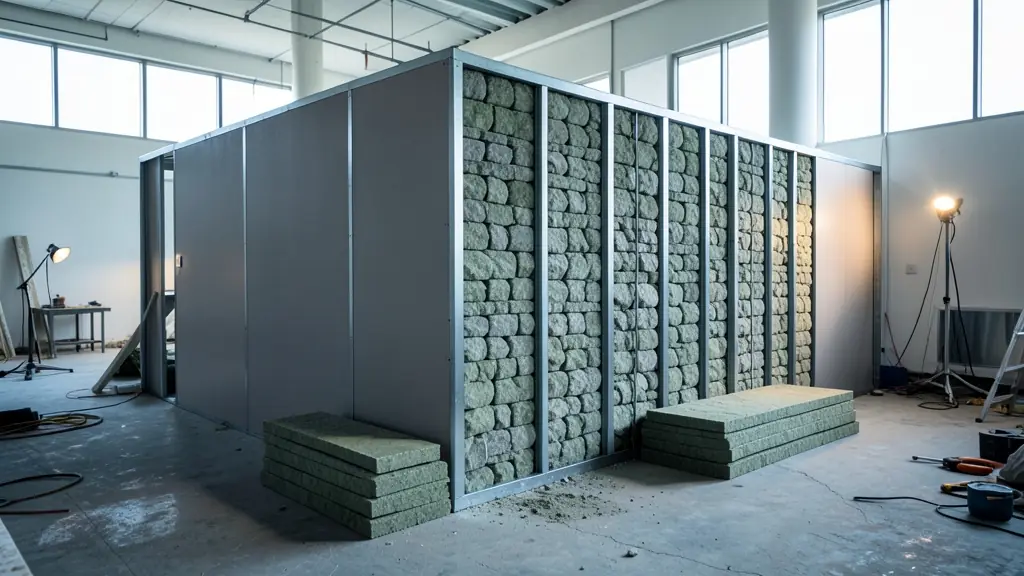
Rockwool is the everyday name for stone wool: insulation spun from volcanic rock such as basalt, melted in a furnace and blown into fibres. It keeps heat out about as well as glass wool, but it is denser, heavier and copes with far higher temperatures. That makes rockwool insulation the pick where fire, sound or heat from a process matters: partitions between offices or flats, ceilings under a noisy roof, around flues and boilers, and in factories. It costs more than a basic ceiling roll, so it earns its place on specific jobs.
What stone wool is
Rock is melted at around 1,500 °C and spun into fibres, which are bonded and pressed into rolls, loose blankets or rigid slabs. Because the fibres are rock, they do not melt until well above 1,000 °C, far beyond what glass wool or polyester can take. Thermal conductivity sits roughly at 0.034 to 0.040 W/mK, so for the same R-value the thickness is close to a glass wool roll. The density is higher, which is what makes it good for sound and why a slab feels heavy in the hand.
Fire: what it can and cannot claim
Plain stone wool is non combustible, and it is used as fire stopping around services and inside fire rated walls. That does not make any wall or ceiling fire rated by itself: the rating belongs to the whole tested system of boards, studs, fixings and wool. Get the tested fire class of the slab from the seller, and leave it to your architect, a fire engineer or the building inspector to say what the building needs. Do not pack any insulation tight against a chimney flue; follow the clearances the flue maker gives.
Sound: partitions, floors and noisy roofs
Dense fibres soak up sound energy in a cavity. A slab inside a stud wall between two offices, or between a lounge and a bedroom in a flat, makes a clear difference, especially with heavier boards on both sides. Over a ceiling under a tin roof it softens rain and hail noise. It will not fix sound that leaks through gaps, so seal around doors and services too. See sound insulation for the wider picture.
Where it goes and how it is laid
- Ceilings: rolls laid like any blanket, often where a building needs a non combustible product.
- Walls and partitions: slabs friction fitted between studs.
- Factories and plant rooms: slabs and pipe sections round hot ducts, ovens and boilers.
- Under steel roofs: faced blankets in commercial roofs.
It itches like glass wool, so wear gloves, long sleeves, a mask and goggles. Work out the rolls with the ceiling insulation calculator.
What to put in your request
- Say if the job is for fire, sound or heat
- Give areas for ceilings and wall lengths
- Name rolls, slabs or pipe sections
- Ask for the fire classification and report
- Mention flues, boilers or hot ducts nearby
Rockwool Insulation: who asks for them and why
- Homeowners and tenants: a quieter bedroom wall, a home studio, or a ceiling under a loud tin roof
- Landlords, complexes and body corporates: partitions and floors between flats where neighbours hear each other through the walls
- Builders, developers and architects: fire and acoustic partitions specified by the architect in multi storey work
- Offices, shops, churches and clinics: office partitions, boardrooms and restaurant kitchens needing sound or fire control
- Warehouses, factories and workshops: insulating ovens, boilers, hot ducts and plant rooms where temperatures run high
- Farms, poultry houses and packsheds: boiler rooms, dairies and packhouse plant rooms with hot pipes to insulate
- Schools, creches and public housing: music rooms and halls where sound between classrooms must be kept down
- Guesthouses, lodges, cabins and wendy houses: guest rooms sharing a wall and lodges with fireplaces and flues in thatch or timber