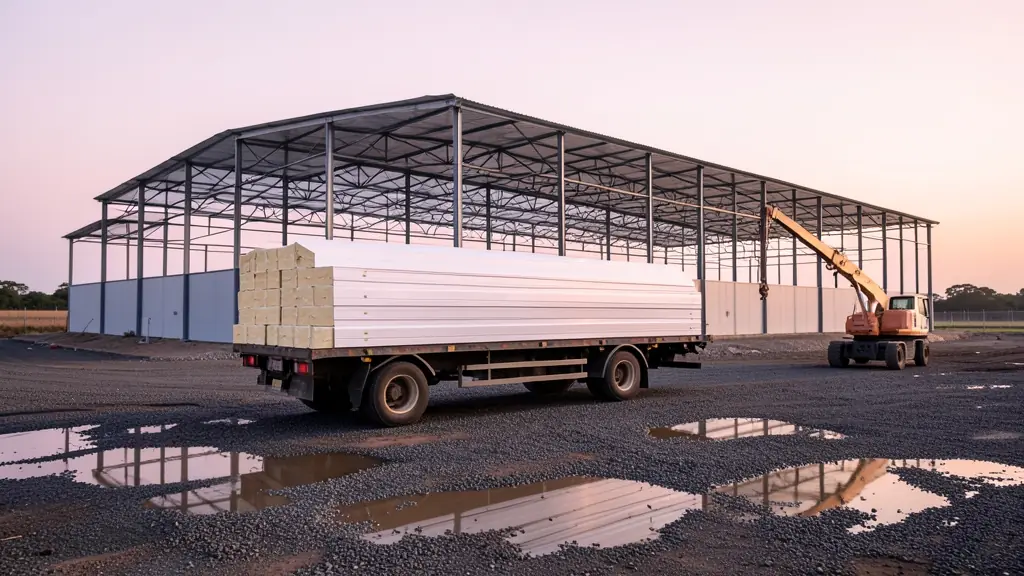
Insulation panels come in two families. Sandwich panels are factory made: two thin steel skins bonded to a thick insulating core, so the roof sheet, the insulation and often the finished ceiling arrive as one piece. Rigid insulation boards are loose sheets of foam or mineral wool fixed under or over an existing roof. Panels go on cold rooms, food factories, site offices, clinics and offices in a hurry. Boards suit retrofits. Both are priced per m², and the core decides most of what you get.
The core: foam or mineral wool
- Polyurethane (PU) and polyisocyanurate. The most common cores. With roughly 0.022 to 0.028 W/mK as a rule of thumb, even a fairly thin panel reaches a high R-value. Polyisocyanurate generally behaves better in fire than plain PU.
- EPS. Expanded polystyrene, lighter on the budget, needs more thickness, and it melts and burns.
- Mineral wool. Heavier and not as warm per mm, chosen where fire matters most.
Each core and skin combination has its own fire test, so request the classification and report for the exact panel you are buying, and have your architect or the building inspector confirm it suits the building.
Thickness, spans and delivery lengths
Roof panels are often 40 to 100 mm thick for offices and sheds; cold rooms and freezers go thicker. Thicker panels give a higher R-value and usually span further between purlins, so the supplier's span table decides the purlin spacing. Panels are cut to the length of the roof slope, which means long loads, a truck that can reach site and often a crane. Tell the supplier about narrow gates, soft ground and overhead cables before delivery day.
Rigid insulation boards under an existing roof
Where the roof is staying, a rigid insulation board fixed under the purlins or between the rafters adds R-value without new sheets. XPS boards around 0.030 to 0.035 W/mK and foil faced foam boards are typical, and some are made with a white face to serve as the ceiling, see Isoboard ceilings. Seal the board joins: gaps let warm, moist air reach the cold sheet and drip. Check the total with the R-value calculator.
Panels or another roof option
Panels pay off when the building is new or the old sheets are coming off anyway, where you would pay for sheets anyway. On a sound roof, spray foam, a foil faced blanket or boards usually cost less than stripping it. Big steel roofs are compared in commercial roof insulation. Get the sloped area from the roof area calculator before you ask.
What to put in your request
- Give the roof length, width and pitch
- Say what the building is for
- Name a core if fire is a concern
- Describe site access for long loads
- Say if old sheets must be stripped
Insulation Panels: who asks for them and why
- Homeowners and tenants: a new flatlet, studio or carport conversion roofed in panels instead of sheets and a ceiling
- Landlords, complexes and body corporates: a guardhouse, refuse room or clubhouse roof done in panels with the inner skin as ceiling
- Builders, developers and architects: fast enclosure on a new build where the panel roof passes the energy figure in one layer
- Offices, shops, churches and clinics: a clinic, showroom or office extension roofed in a week with a finished white ceiling
- Warehouses, factories and workshops: cold stores, food factories and clean rooms where hygiene and steady temperature matter
- Farms, poultry houses and packsheds: a cold room for fruit, a milking parlour or a poultry house roof in foam core panels
- Schools, creches and public housing: mobile classrooms and site offices built from panels for quick, insulated space
- Guesthouses, lodges, cabins and wendy houses: panel cabins and chalets on remote sites where trucks bring everything in one load