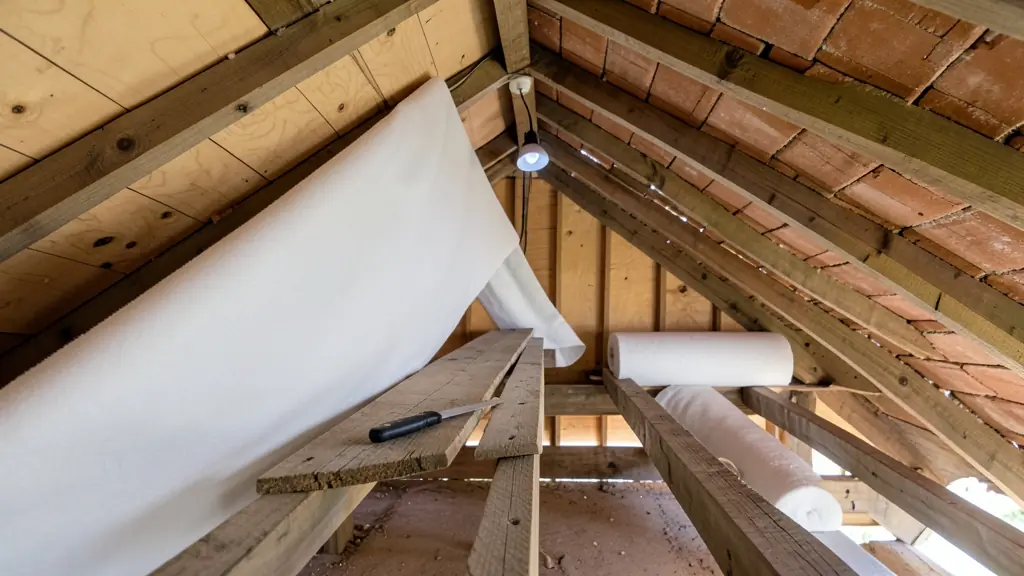
Knowing how to install ceiling insulation saves you the labour on a fitted quote, and on a simple pitched roof with a good hatch it is a fair job for two people on a Saturday. Installing ceiling insulation is mostly crawling, rolling and cutting; the skill is in leaving no gaps and not putting a foot through the ceiling. Below is the order that works, the kit you need and the mistakes we hear about most. If your roof is low, hot, full of downlights or holds old wool that looks bad, get a crew in instead.
Before you go up: measure, buy, kit up
Measure each room's length and width and add them up for the ceiling area. Leave out open stoeps and carports with no ceiling. Read the cover in m² on the roll and work out how many you need, plus 5 to 10% spare; the ceiling insulation calculator does it with the R-value. You need a head torch or a work light, a sharp long blade knife, a plank or two, gloves and a dust mask. For glass wool add long sleeves, goggles and a cap. Polyester does not itch, which is why many people choose it for DIY.
Laying it: the order that works
- Pass the rolls up first and open them in the roof: they expand.
- Start at the far end from the hatch and work back towards it.
- Walk only on the trusses or on a plank across them. The ceiling board will not hold you.
- Push each roll right into the eaves and up against the wall plate, then roll it out between the trusses.
- Butt the ends tight to the next roll, with no gap and no overlap pile up.
- Cut neatly round truss struts, braces and cables instead of bunching the blanket.
- For a second layer, lay it across the first at right angles to cover the tops of the trusses.
- Cut a piece for the back of the hatch lid last.
What to keep clear
Downlights without a rating for being covered, plus their transformers and junction boxes, need a clear space around them or covers their maker approves. Do not bury the geyser's element and thermostat housing. Lay the blanket over cables, never pinch or staple them, and leave enough slack for an electrician to find them. Leave ventilation openings at the eaves clear.
What not to do
- Don't work at midday in summer. Go up at first light.
- Don't squash the blanket to fit or store boxes on it later.
- Don't lay new rolls over wool that is wet, nested or soiled; see insulation removal.
- Don't touch anything that could be asbestos; a registered asbestos contractor handles that.
What to put in your request
- Give the ceiling area in m²
- Say which material you prefer to handle
- Ask what area each roll covers
- Ask for delivery to the house
- Say if old insulation is up there
How to Install Ceiling Insulation: who asks for them and why
- Homeowners and tenants: two people with rolls and a plank doing a bungalow ceiling on a Saturday
- Landlords, complexes and body corporates: an owner topping up a single unit before the body corporate gets to the whole block
- Builders, developers and architects: a small renovator laying rolls in an addition before the inspector's final visit
- Offices, shops, churches and clinics: a shop owner insulating a small office ceiling after hours to cut the aircon bill
- Warehouses, factories and workshops: maintenance staff laying rolls over a site office or canteen ceiling between shifts
- Farms, poultry houses and packsheds: laying rolls in a farm cottage or store room with labour already on the farm
- Schools, creches and public housing: a parents' work day insulating a creche or classroom ceiling with donated rolls
- Guesthouses, lodges, cabins and wendy houses: an owner insulating a cabin or wendy house ceiling where a crew would have to travel far