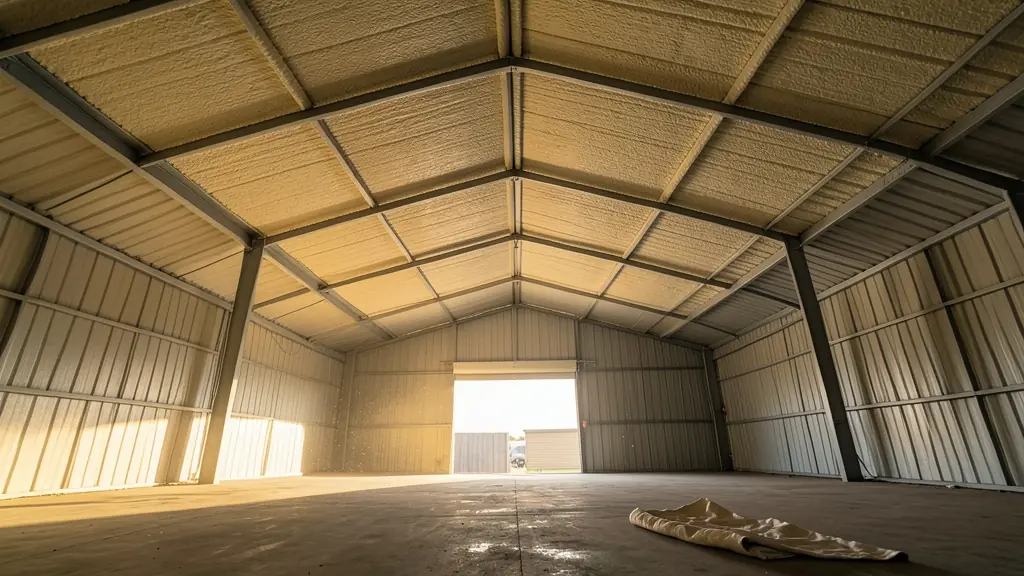
Spray foam insulation is liquid polyurethane that an applicator sprays onto the underside of the roof sheets, where it expands within seconds and sets into a firm layer stuck to the metal. Because it goes on wet, it fills the ribs of IBR, the laps and the bolt holes that a blanket bridges over. That makes it popular on steel roofs with no ceiling, on sheds that drip condensation and on tin roofs that roar in the rain. It is also one of the dearer options, so it pays to know what you are buying.
Closed cell or open cell
Closed cell foam is dense and rigid. As a rule of thumb its conductivity, somewhere near 0.022 to 0.028 W/mK, means a thin coat does a lot of work, and it blocks water vapour, which is why it stops the winter drip under bare sheets. It also stiffens old sheets a little. Open cell foam is lighter and softer, uses less chemical per m², soaks up more sound, but lets vapour through and needs more thickness for the same R-value. Most South African roof work is closed cell; ask which one the quote is for and at what average thickness.
What it does well, and the catches
- No gaps at the purlins, laps or wall plates, because the foam follows the shape of the sheet.
- Rain and hail drum far less once the sheet is damped.
- Warm air no longer meets cold metal, so condensation stops.
The catches: overspray drifts onto cars, walls and anything left inside, so the applicator must mask and you must clear the space. Foam bonded to the sheet makes later roof repairs messier. Spraying the underside of tiles or over wet, rotten timber traps problems out of sight. Fix leaks first.
The fire coating question
Polyurethane foam burns and gives off thick smoke. Many buildings, especially shops, halls and workplaces, need the foam covered with a fire retardant or intumescent coating, or another barrier, and some uses rule it out. We cannot tell you what your building needs. Get the fire classification and the test report for the whole foam and coating system in writing from the applicator, and let the building inspector or your architect confirm it for plans. Compare it with insulation panels or stone wool if fire is the deciding point.
What a per m² quote should include
Foam is priced per m² of roof at a stated thickness. The applicator measures the sloped area (the roof area calculator gets you close), allows for access by scaffold or a scissor lift and for masking. A fair quote names closed or open cell, the average thickness, the R-value claimed, any fire coating, the masking and cleaning, travel and VAT. Two quotes at different thicknesses are not comparable until you convert both to R-value with the R-value calculator.
What to put in your request
- Give the roof footprint and pitch
- Say whether the roof is IBR, corrugated or tiled
- Mention any leaks or rusted sheets
- Say what is inside that needs masking
- Ask if a fire coating is included
Spray Foam Insulation: who asks for them and why
- Homeowners and tenants: a converted garage or loft room under bare tin that drips and roars when it rains
- Landlords, complexes and body corporates: carports and storerooms under one long steel roof, priced across the whole block at once
- Builders, developers and architects: a steel roof on a new double volume room where no ceiling will go in
- Offices, shops, churches and clinics: a restaurant or church hall under sheets that are too loud for talking in a storm
- Warehouses, factories and workshops: a portal frame workshop roof sealed against condensation dripping onto machines and stock
- Farms, poultry houses and packsheds: a broiler house or packshed roof that cooks the birds or the fruit in summer
- Schools, creches and public housing: a school hall roof where rain noise drowns out assemblies, with the fire coating confirmed
- Guesthouses, lodges, cabins and wendy houses: a container cabin or steel chalet in the bush that bakes by day and chills at night