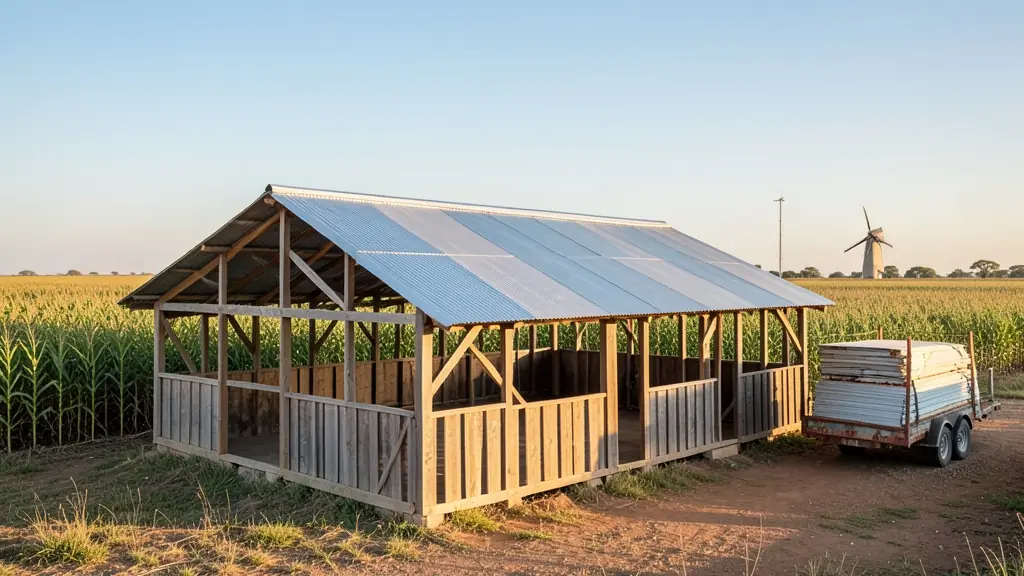
Roof insulation foil is a thin sheet with a bright aluminium face, sometimes on both sides of a woven reinforcing layer, sometimes bonded to a layer of plastic bubbles. Laid under tiles or sheets, it reflects the radiant heat coming off a hot roof and stops much of it reaching the roof space. Laid well, it cuts summer heat noticeably and keeps dust and wind blown rain out. Laid badly, against the sheet with no air gap or under a coat of dust, it does very little.
The air gap rule and the shiny side
Foil does not slow heat the way a blanket does. It works because a shiny surface gives off and takes in very little radiant heat, and that only helps if there is still air next to it. Pressed tight against a sheet or a tile, the heat simply conducts through. So the foil must face an air gap of at least a few centimetres. Dust settling on an upward facing shiny side dulls it within a few years, which is why many installers say the downward facing side, which stays clean, does most of the long term work.
Laying it over the purlins
- Run the foil across the rafters or purlins, starting at the eaves so each higher run laps over the one below, like the tiles.
- Lap the edges about 150 mm and tape the joins on sheet roofs.
- Let it sag a little between supports. The sag gives the air gap and lets any water that gets in run down to the gutter.
- Keep the foil out of the gutter itself so it drains outside.
Work out how many rolls with the roof area calculator: it adds the slope and the laps for you.
Reflective laminate or bubble foil
Plain reflective laminate is thin, tough and cheap per m². Bubble foil adds a few millimetres of trapped air, so it gives a little more resistance where it touches the sheet, and some types damp rain noise a bit. Neither is a thick insulator. On a metal roof, a foil faced blanket laid over the purlins does both jobs at once, see metal roof insulation.
Why foil alone is not enough in winter
Foil is best at blocking radiant heat coming down in summer. In a Highveld or Free State winter the problem is heat leaking up from the rooms by conduction and moving air, and a single foil layer does little to slow that. On its own it falls well short of the total that SANS 10400-XA expects for a new roof. The pairing that works is foil under the roof plus a blanket on the ceiling. Check the combined R-value with the R-value calculator and read roof insulation for the full picture.
What to put in your request
- Say if the roof is new, being redone or existing
- Give the footprint and roof pitch
- Say tiles, IBR or corrugated sheets
- Mention whether the ceiling has insulation
- Ask for supply only or supplied and fitted
Roof Insulation Foil: who asks for them and why
- Homeowners and tenants: foil under new tiles when the old roof comes off, paired with a ceiling blanket
- Landlords, complexes and body corporates: a re-roofing project across all the units where foil goes in while the sheets are off
- Builders, developers and architects: foil laid over purlins as standard on every new roof before the sheets go down
- Offices, shops, churches and clinics: a shop or office extension roof where foil keeps the dust and summer heat out
- Warehouses, factories and workshops: a warehouse roof replacement with foil catching drips before they reach the racking
- Farms, poultry houses and packsheds: a new implement shed or dairy roof with foil draped between the purlins
- Schools, creches and public housing: new classroom blocks where foil and a ceiling blanket go in from the start
- Guesthouses, lodges, cabins and wendy houses: a thatch free chalet or wendy house roof with foil under the sheets