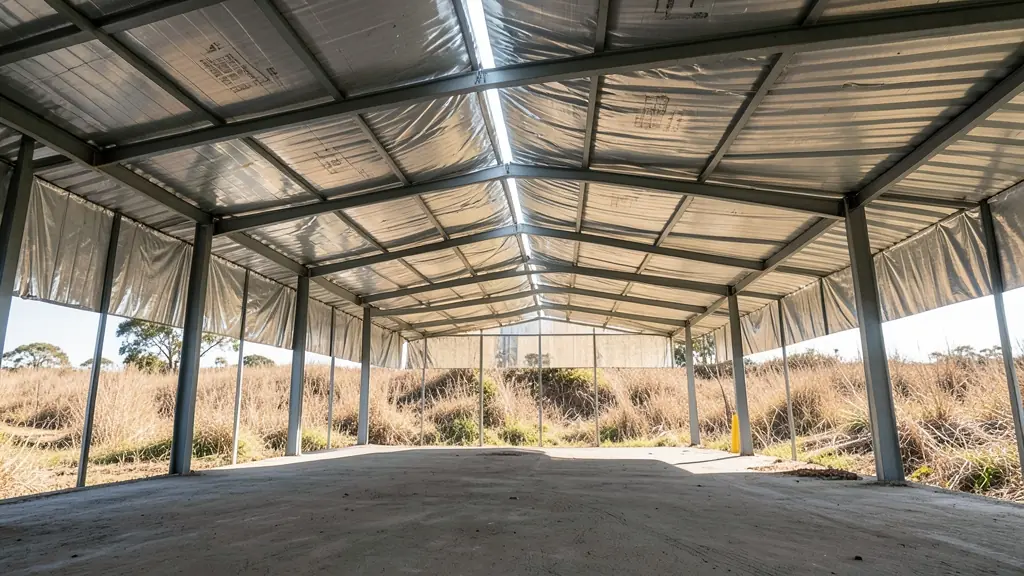
Roof insulation for a metal roof has three jobs that a tiled roof barely asks for. Bare IBR or corrugated sheets turn into a radiator on a January afternoon, they sweat on the underside on a still winter night and drip onto whatever sits below, and they drum under every rain shower and hailstorm. The right layer stops all three, but only if it is chosen for the roof you have: new sheets going on, or old sheets that stay. Here is how installers tackle each case.
Why a tin roof behaves so badly
Steel sheeting is thin and conducts heat almost instantly, so the inside face runs nearly as hot as the outside. A dark sheet in full sun can push the space beneath past 50 °C, and that heat radiates straight down onto the ceiling or onto people in an open shed. At night the sheet loses heat to a clear sky and drops below the air temperature. Warm, damp air from the room meets that cold steel and condenses. In a house, the drips stain the ceiling boards; in a workshop, they rust tools and wet stock. Treat condensation as a moisture fault first, then a heat one.
New sheets: lay it over the purlins
The cheapest moment to insulate is when the roof is open. The installer rolls a layer over the purlins, laps the edges about 150 mm and lets it sag slightly between purlins so the foil has an air gap below it. Options:
- Reflective foil laminate: cuts radiant heat and acts as a vapour and dust barrier.
- A glass wool or polyester blanket with a foil face: adds real R-value and quietens the rain.
- Sandwich panels: the sheet and the core in one, for cold rooms and new buildings.
Old sheets that stay: fix it from below
If the sheets are sound, nobody wants to strip them. From underneath you can have spray foam applied straight to the steel, which bonds, seals the laps and stops condensation at the source. Or rigid boards are screwed to the purlins or fixed under the rafters as a ceiling. A blanket on a new ceiling below also works where the room allows the height. Check the sheets first: rusted laps and loose screws must be fixed before anything covers them.
Hail and rain noise
Mass and softness quieten a sheet. A foil alone does little for noise; a blanket of 50 mm or more, or foam stuck to the steel, damps the drumming far better. See sound insulation for rooms where it matters most. To size the job, the roof area calculator turns your footprint and pitch into square metres of sheet.
What to put in your request
- Say if the sheets are new or staying on
- Give the profile: IBR, corrugated or other
- Mention any drips or rust you have seen
- Say whether there is a ceiling below
- Note how high the roof is off the floor
Metal Roof Insulation: who asks for them and why
- Homeowners and tenants: an upstairs room under bare IBR that bakes in summer and drips on frosty mornings
- Landlords, complexes and body corporates: townhouse rows with corrugated roofs where each unit's ceiling stains from condensation
- Builders, developers and architects: foil or a faced blanket laid over the purlins before the sheets go on a new build
- Offices, shops, churches and clinics: a shop or church hall under tin where rain drowns out speech and aircon struggles
- Warehouses, factories and workshops: workshops and stores where drips rust tools and wet stock under the sheeting
- Farms, poultry houses and packsheds: sheds, stables and implement stores with bare sheets that sweat through the winter
- Schools, creches and public housing: prefab classrooms and halls with metal roofs that roar in a summer thunderstorm
- Guesthouses, lodges, cabins and wendy houses: chalets and container rooms under tin that need to sleep cool and quiet