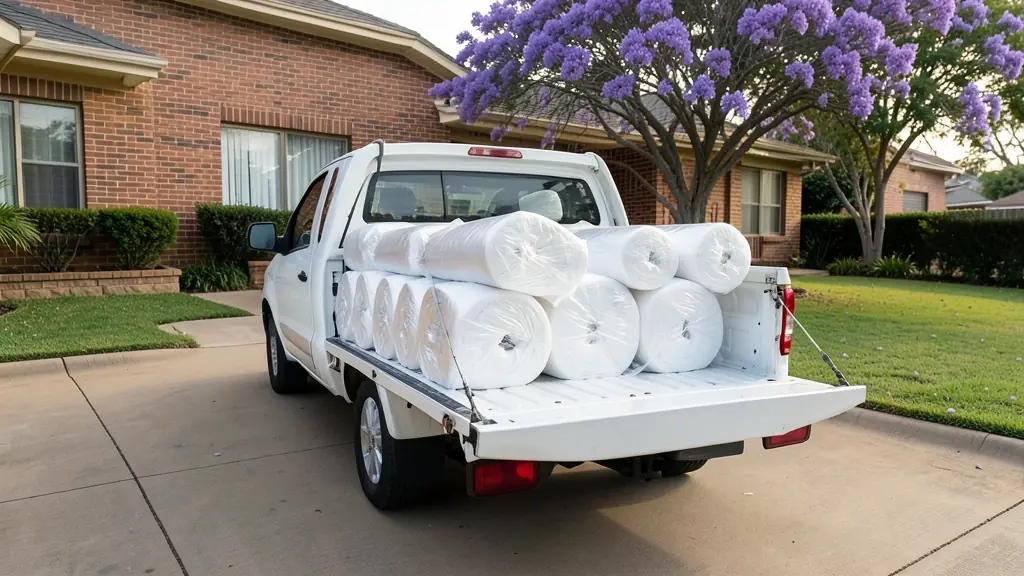
Ask a homeowner who has laid both, and most will tell you the same thing: isotherm insulation is the one you can handle without gloves and a long shirt. Isotherm is a maker's trade name for a polyester ceiling blanket spun from recycled plastic bottles, and the suppliers who answer may price that exact roll or a comparable polyester one. It comes white or grey, sheds no fibres and does not make you itch, which makes it a favourite for DIY jobs, homes with allergy sufferers and roofs with a tight crawl space.
What the blanket is made of
Used PET bottles are cleaned, shredded and spun into fine polyester fibres, which are bonded into a springy mat by heat rather than glue. The fibres trap still air, and still air is what slows heat. Its conductivity lands near 0.035 to 0.045 W/mK, much like glass wool, so for the same R-value you need a similar thickness. The difference is in the handling: there is no loose dust to breathe, no prickle on your arms, and nothing that drifts down through the gaps around a hatch or a downlight.
Thicknesses people ask for
- 40 to 50 mm: thin rolls for topping up an old layer or for walls and partitions.
- 75 to 100 mm: a middle option where the roof space is cramped or the budget is tight.
- 135 to 145 mm: the usual choice for a full ceiling job aiming at the SANS 10400-XA figure on its own.
Check the R-value on each roll rather than going by thickness, and use the R-value calculator if you are adding a layer over what is already there.
Damp, rats and the roof space
Polyester does not soak up water the way some fibres do, so a small leak that drips onto it dries out without the blanket collapsing. Fix the leak anyway: wet ceiling boards sag whatever lies on them. Rodents do not eat polyester, though they will still nest in any warm, quiet material, so seal the gaps at the eaves. On fire, get the roll's tested fire classification in writing from whoever sells it, not a line from a brochure. Leave space around any downlight that may not be covered, and around the geyser element cover.
Roll sizes and working out how many
Roll length and width change with thickness: a thin roll covers far more m² than a thick one, and the pack states the area it covers. Divide your ceiling area by that figure and add about 5 % for cutting around trusses and the hatch. The ceiling insulation calculator does the sum. Unroll a blanket and let it recover its loft for a while before laying, because it is compressed hard in the pack.
What to put in your request
- Give the ceiling area and the roof type
- Say if old insulation stays or goes
- Name the thickness or the R-value you want
- Say if an equivalent polyester is fine
- Ask for delivery or fitting in the price
Isotherm Insulation: who asks for them and why
- Homeowners and tenants: a weekend DIY job in a tight roof space with no itchy fibres or dust
- Landlords, complexes and body corporates: rental units where tenants and kids live below and loose fibres are unwelcome
- Builders, developers and architects: new houses and additions specified with a polyester blanket to meet the plans
- Offices, shops, churches and clinics: clinics, creches and offices where dust from the ceiling must stay out
- Warehouses, factories and workshops: canteens and site offices under hot roofs where staff lay the rolls themselves
- Farms, poultry houses and packsheds: farmhouses and stores where a small roof leak should not ruin the blanket
- Schools, creches and public housing: classrooms and halls where clean, low dust material suits a school setting
- Guesthouses, lodges, cabins and wendy houses: chalets and cabins where a two person team can lay rolls in an afternoon